
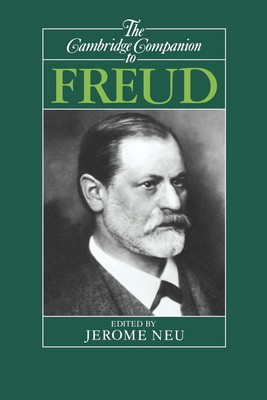
The Cambridge Companion to Freud
Богословский клуб Эсхатос
Члены клуба имеют полный доступ к фондам клуба для личного ознакомления. Членство платное: для активации нужен вступительный взнос, условия — в правилах клуба.
Войти
Как вступить в клуб
Правила клуба
Despite distorted understandings of Freud's views and despite periodic waves of Freud-bashing, Auden's assessment remains essentially correct. Freud's influence continues to be enormous and pervasive. He gave us a new and powerful way to think about and investigate human thought, action, and interaction. He made sense of ranges of experience generally neglected or misunderstood. And while one might wish to reject or argue with some of Freud's particular interpretations and theories, his writings and his insights are too compelling to simply turn away. There is still much to be learned from Freud.
The essays here collected focus on some of Freud's masterworks and some of his central concepts, trying to bring out the structure of his arguments and contributions to our self-understanding.
Freud was born in 1856 in Freiberg in Moravia, but after his family's move when he was four years old, he passed almost all of his long life in Vienna. The story of his life is the story of his thought. The great events were most often the occasions of his discoveries and speculations. After his childhood move, the rest of his life can be viewed as a tale of four cities, the psychogeography of which is explored by Carl Schorske. Vienna, embroiled in anti-Semitism, was the ambivalent scene of Freud's professional advances and defeats as well as home to his contented family life. London was, from the beginning until his flight there from Hitler in the last months of his life, capital of the land of hope and order, ideal site of the liberal ego. Paris, on the other hand, place of his early studies of hysteria with Charcot, provided the romantic center for his imagination, offering the attractions of the dangerous and alluringly irrational id. And finally Rome, embodying layers of history through which the archeologist can dig just as the depth psychologist can excavate the buried past, was the unapproachable city of his youthful ambitions and adult dreams, and it became the locus for a fitful reconciliation of polarities.
The Cambridge Companion to Freud
Edited by Jerome Neu, 2008
Introduction. JEROME NEU
1. Freud: The psychoarcheology of civilizations. CARL E. SCHORSKE
2. Seduced and abandoned: The rise and fall of Freud's seduction theory. GERALD N. IZENBERG
3. Freud's androids. CLARK GLYMOUR
4. The interpretation of dreams. JAMES HOPKINS
5. The unconscious. SEBASTIAN GARDNER
6. The development and vicissitudes of Freud's ideas on the Oedipus complex. BENNETT SIMON AND RACHEL B. BLASS
7. Freud and perversion. JEROME NEU
8. Morality and the internalized other. JENNIFER CHURCH
9. Freud on women. NANCY J. CHODOROW
10. Freud and the understanding of art. RICHARD WOLLHEIM
11. Freud's anthropology: A reading of the "cultural books". ROBERT A. PAUL
12. Freud's later theory of civilization: Changes and implications. JOHN DEIGH
13. In fairness to Freud: A critical notice of The Foundations of Psychoanalysis, by Adolf Griinbaum. DAVID SACHS

Комментарии
Пока нет комментариев. Будьте первым!